
Description
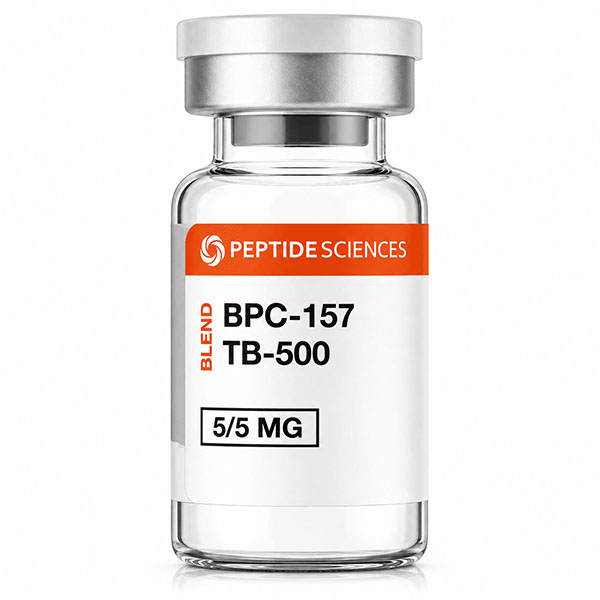
BPC-157 5mg + TB-500 5mg Blend
Experimental Peptide Blend | Laboratory & Analytical Research
BPC-157 5mg + TB-500 5mg Blend is a defined multi-peptide research formulation combining BPC-157 and TB-500 in an equal 1:1 ratio, providing 10mg of total peptide content.
Both peptides have been investigated independently in preclinical research involving cellular signaling, vascular biology, cell migration, and tissue-related biological processes. Research specifically evaluating this combined formulation is limited, so findings associated with the individual compounds should not be presented as established effects of the blend.
Composition
| Peptide | Amount |
|---|---|
| BPC-157 | 5mg |
| TB-500 | 5mg |
| Total Peptide Content | 10mg |
| Ratio | 1:1 |
BPC-157 — 5mg
BPC-157 is a synthetic 15-amino-acid peptide studied primarily in laboratory and animal research. Experimental work has investigated pathways associated with cellular signaling, angiogenesis-related mechanisms, vascular biology, gastrointestinal models, and tissue-response processes.
Available evidence remains predominantly preclinical and does not establish proven therapeutic effects in humans.
TB-500 — 5mg
TB-500 is a synthetic peptide related to thymosin beta-4. Experimental research has examined mechanisms involving cell migration, actin-associated processes, angiogenesis-related pathways, and cellular/tissue biology.
Researchers should distinguish research involving TB-500 from studies conducted using full-length thymosin beta-4.
Key Research Advantages
Balanced 1:1 Formulation
Contains 5mg of BPC-157 and 5mg of TB-500, providing a clearly defined equal-ratio formulation.
Dual-Peptide Research Platform
Combines two experimental peptides in a single preparation for controlled comparative studies.
Complementary Research Areas
The individual compounds have been studied in overlapping areas of cellular and tissue biology, including cell signaling, vascular pathways, and cellular migration.
Convenient Research Format
Provides 10mg total peptide content in one defined blend, simplifying comparative laboratory formulation studies.
Comparative Research Potential
Can be evaluated against the individual peptides to investigate differences between single-compound and combined formulations.
Potential Research Areas
The blend may be examined in laboratory research involving:
- Cellular signaling
- Cell migration
- Angiogenesis-related pathways
- Vascular biology
- Connective-tissue research
- Experimental tissue-response models
- Peptide structure–activity studies
- Comparative peptide research
- Stability and formulation studies
- Analytical peptide characterization
Product Specifications
Product Name: BPC-157 5mg + TB-500 5mg Blend
BPC-157: 5mg
TB-500: 5mg
Total Peptide Content: 10mg
Ratio: 1:1
Category: Experimental peptide blend
Form: Peptide research formulation
Intended Application: Laboratory and analytical research
Documentation: Batch-specific COA recommended
Quality & Testing
For legitimate research applications, relevant batch documentation may include:
- BPC-157 identity and content
- TB-500 identity and content
- Individual peptide purity
- Total peptide content
- Molecular characterization
- Batch or lot number
- Stability information
- Certificate of Analysis (COA)
- Applicable analytical test results
Research & Formulation Notes
Peptide preparations can vary in purity, aggregation, degradation, and formulation characteristics. Researchers should therefore verify the finished blend using appropriate analytical methods rather than relying solely on nominal labeled content.
A batch-specific COA can help confirm identity, purity, concentration, and formulation consistency.
Important Disclaimer
This product is an experimental peptide formulation intended strictly for laboratory research and analytical purposes. It is not intended for human or veterinary consumption, diagnosis, treatment, prevention, or mitigation of disease.
The specific BPC-157 5mg + TB-500 5mg combination has not been adequately established through clinical studies as safe or effective for human use. Research findings involving the individual peptides should not be represented as proven clinical benefits of the combined formulation.
GHK-CU-50mgTB500-10mgBPC157-10mgKPV-10mg-Blend-500x500.jpg)
Leave a Reply