
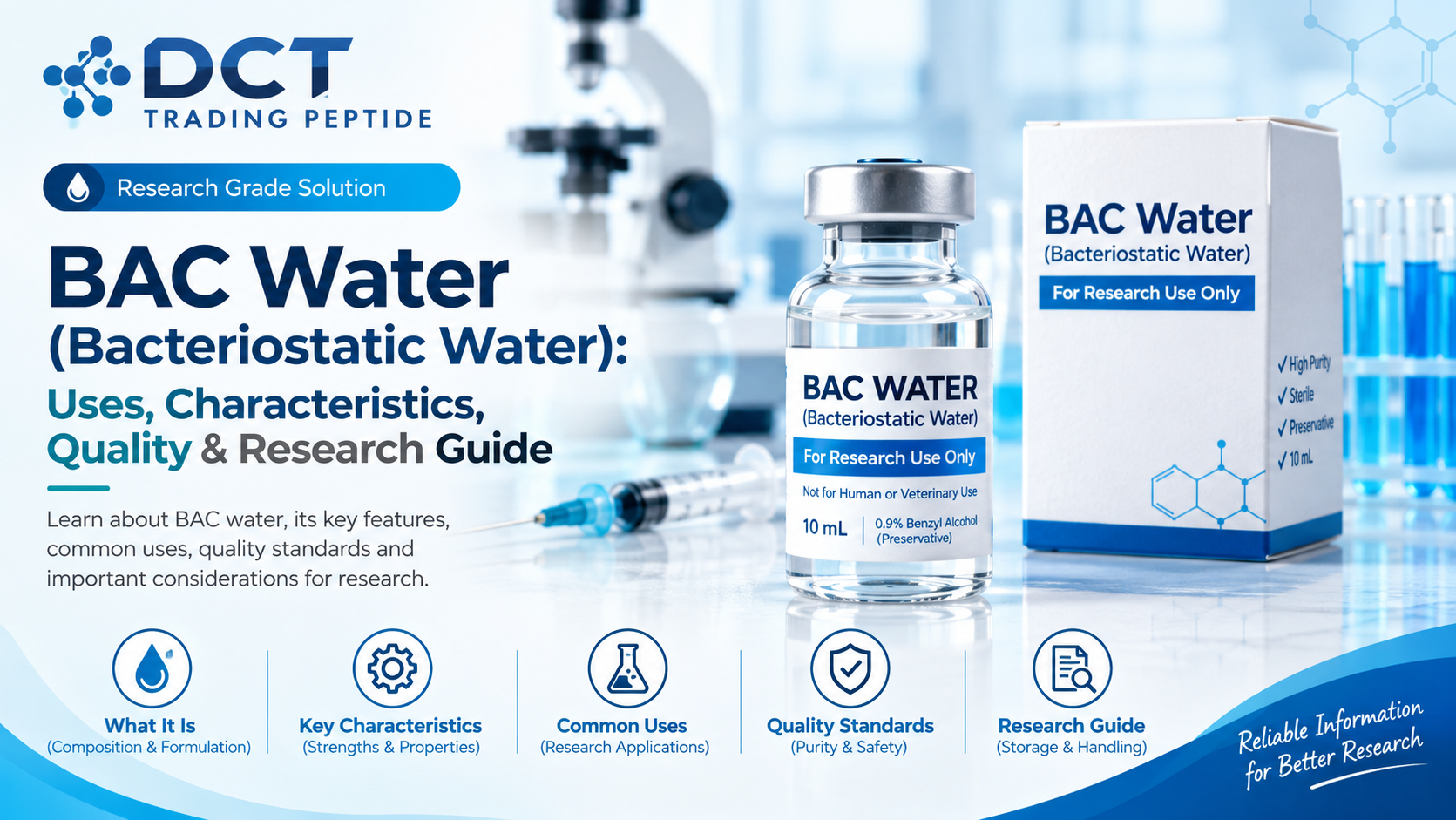
BAC Water (Bacteriostatic Water) is a laboratory solution commonly discussed in scientific research, analytical procedures, and controlled laboratory workflows. Its suitability for a particular application depends on its formulation, documented specifications, quality information, and intended use.
At DC Trading Peptide, product information helps researchers understand the characteristics and documentation associated with individual research products. This guide explains BAC Water, its general laboratory applications, quality considerations, storage requirements, and important product evaluation factors.
For product-specific information, visit the BAC Water product page at DC Trading Peptide.
What Is BAC Water (Bacteriostatic Water)?
BAC Water is a commonly used abbreviation for Bacteriostatic Water. Certain formulations contain a preservative intended to inhibit bacterial growth under specified conditions. However, the exact ingredients, preservative concentration, and other characteristics depend on the individual product.
In laboratory settings, a suitable diluent may provide an aqueous medium for selected research procedures. Researchers should evaluate its documented properties before determining whether it meets the requirements of a particular experiment.
It is also important to distinguish laboratory research products from pharmaceutical preparations. A product marketed for research should not automatically be considered sterile, suitable for injection, or approved for human use.
Key Characteristics of BAC Water
When evaluating BAC Water from DC Trading Peptide, researchers should review the available product information to understand its documented characteristics.
- Product name: BAC Water
- Common description: Bacteriostatic Water
- Product category: Laboratory solution or diluent
- General application: Selected scientific and analytical workflows
- Product documentation: Specifications and batch information, where available
- Composition: To be verified through the applicable product documentation
- Storage requirements: Follow the instructions provided for the specific product
The precise formulation, packaging, preservative system, and quality specifications should always be confirmed through current product documentation.
Common Research Applications of BAC Water
A laboratory diluent may support different research activities when its characteristics are compatible with the relevant procedure.
1. Research Solution Preparation
Scientific procedures may require supporting solutions with documented properties. Researchers should determine whether a particular diluent is suitable for their intended experiment before using it in a laboratory workflow.
2. Analytical Laboratory Procedures
Analytical research can involve materials that meet specific quality and compatibility requirements. Selecting an appropriate solution requires consideration of the analytical method and the laboratory’s established procedures.
3. Controlled Dilution Workflows
Some laboratory experiments involve dilution procedures that require a suitable liquid medium. Researchers should verify compatibility and composition rather than assume that all aqueous solutions are interchangeable.
4. Laboratory Quality Control
Product identification, batch traceability, and quality documentation can help laboratories maintain accurate research records. These details support material evaluation and consistent documentation practices.
These examples describe general laboratory activities. They do not establish that every product sold as BAC Water is suitable for every research application.
BAC Water Specifications: What Should Researchers Check?
Before selecting a laboratory solution, researchers should review the product specifications relevant to their work.
Composition and preservative information: Check the stated ingredients and preservative details, where applicable.
Product identity: Confirm the product name, formulation, and documented intended use.
Batch or lot number: Review identification information to support traceability.
Certificate of Analysis (COA): If available, examine the reported test results and specifications to determine whether they meet the relevant research requirements.
Quality-control information: Review available analytical results and product quality information.
Packaging and storage: Follow the instructions supplied for the specific product.
Researchers can find product-specific information through the DC Trading Peptide BAC Water product listing. Any specifications or quality claims should be confirmed against the current documentation.
Why Is Product Documentation Important?
Reliable product documentation helps researchers evaluate whether a laboratory material meets their requirements. It can also help distinguish between products that share a general name but have different formulations.
Depending on the product, available documentation may include:
- Product identity and composition
- Batch or lot identification
- Analytical test results
- Quality specifications
- Certificate of Analysis, where available
- Storage and handling instructions
A Certificate of Analysis does not automatically establish suitability for every application. Researchers should review the specific tests reported and confirm that the results are relevant to their intended research work.
BAC Water Storage and Handling
Storage and handling requirements may vary according to the formulation, packaging, and manufacturer’s instructions. Researchers should therefore follow the guidance supplied with the specific product rather than assume that one storage condition applies universally.
Good laboratory practices include maintaining product identification, preventing contamination, following institutional safety procedures, and recording relevant handling information.
If the product documentation does not provide sufficient information, contact the supplier for clarification before determining whether the material is suitable for the intended workflow.
BAC Water vs. Peptides: What Is the Difference?
BAC Water and peptides have different roles in scientific research.
BAC Water is a solution that may serve as a supporting diluent, depending on its formulation and intended application. Peptides are molecules made up of amino acid chains that researchers investigate for different biological properties.
Understanding this distinction helps researchers evaluate laboratory materials according to their actual function. A diluent is not itself a peptide, and its suitability depends on the requirements of the specific procedure.
Frequently Asked Questions About BAC Water
What is BAC Water?
BAC Water is a common abbreviation for Bacteriostatic Water. Depending on its verified formulation and intended application, a suitable product may serve as a supporting solution in selected laboratory workflows.
Is BAC Water a peptide?
No. BAC Water is a solution rather than a peptide or an active peptide research compound.
Does all BAC Water have the same composition?
No. Ingredients, preservative systems, packaging, and quality specifications may vary between products and suppliers. Always review the applicable product documentation.
What is a COA for BAC Water?
A Certificate of Analysis is a document containing specified product or batch information and test results. Its contents depend on the product and the supplier’s documentation.
How should BAC Water be stored?
Follow the storage instructions supplied with the specific product. Do not assume that the same storage conditions apply to every formulation.
Is laboratory BAC Water suitable for human use?
A product marketed for laboratory research should not automatically be considered suitable for injection or human use. Such suitability requires the appropriate product status, quality controls, and applicable authorization.
Why Consider DC Trading Peptide?
DC Trading Peptide provides a product listing for BAC Water, allowing interested visitors to review the information available for this laboratory solution.
Before selecting a product, researchers should examine the applicable specifications, confirm the intended use, and review any available quality documentation. Product decisions should be based on verified information rather than assumptions about products with similar names.
For additional information, visit the BAC Water product page or contact DC Trading Peptide using the details below.
Contact DC Trading Peptide
Business location: Rozenburg, Netherlands
Address: 7PHJ+R3, Rozenburg, Netherlands
Sales and support: +31 97005034335
WhatsApp: +31 97005033245
Email: info@dctradingpeptide.com
Website: https://dctradingpeptide.com/
Conclusion
BAC Water (Bacteriostatic Water) is a laboratory solution whose suitability depends on its formulation, documented quality, and intended application. Reviewing product specifications, available batch records, and storage instructions helps researchers make informed decisions about laboratory materials.
DC Trading Peptide provides a dedicated BAC Water product listing for visitors seeking product-specific information. Always consult the applicable documentation and follow relevant laboratory safety requirements before selecting or handling research materials.
Research Disclaimer: This article is intended for general educational and laboratory research information. It does not provide medical advice or instructions for human administration, treatment, or self-medication. Always follow applicable laboratory safety procedures, product-specific guidance, and local regulations.


Leave A Comment