
Description
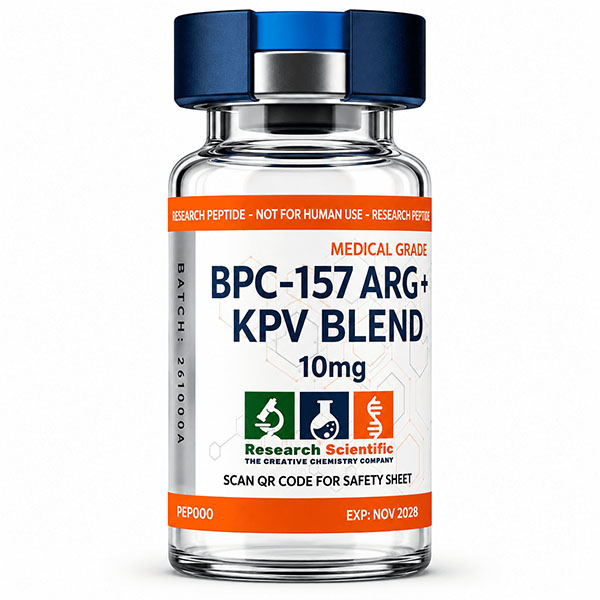
BPC-157 Arg
Arginine-Salt Form of BPC-157 | Experimental Peptide Research Compound
BPC-157 Arg refers to a formulation of BPC-157 associated with arginine (Arg), typically used to distinguish the material from other BPC-157 presentations. BPC-157 itself is a synthetic 15-amino-acid peptide that has been investigated primarily in preclinical research involving cellular signaling, vascular biology, gastrointestinal models, and tissue-related pathways.
The arginine-associated formulation can be of interest in peptide chemistry and analytical research where researchers want to characterize the material’s identity, purity, salt/formulation properties, stability, and biological behavior.
Key Characteristics of BPC-157 Arg
- Product: BPC-157 Arg
- Base Peptide: BPC-157
- Peptide Length: 15 amino acids
- Form: Arginine-associated formulation/salt form
- Category: Experimental peptide
- Research Stage: Primarily preclinical
- Research Areas: Peptide chemistry, cellular signaling, vascular biology, and tissue-related research
BPC-157 Arg Research Profile
BPC-157 has been investigated in laboratory and animal studies examining processes associated with cellular signaling, angiogenesis-related pathways, vascular responses, gastrointestinal biology, and tissue-response mechanisms.
The “Arg” designation is important for product characterization because different peptide forms or salt presentations can have different physicochemical properties. Researchers should therefore verify the exact chemical form and composition through supplier documentation and analytical testing rather than assuming that all BPC-157 products are chemically identical.
Research Applications
BPC-157 Arg may be investigated in controlled laboratory research involving:
- Peptide chemistry and characterization
- Cellular signaling studies
- Vascular biology
- Angiogenesis-related research
- Gastrointestinal research models
- Experimental tissue-response models
- Peptide stability studies
- Structure–activity relationship research
- Comparative formulation studies
- Analytical purity and identity testing
Research Advantages
Defined Peptide Formulation
Provides researchers with a specified BPC-157 formulation for controlled analytical investigation.
Peptide Chemistry Research
Useful for studying how formulation or salt-associated characteristics may influence physicochemical properties.
Comparative Research
Can be compared with other BPC-157 formulations to investigate differences in identity, stability, solubility, and analytical behavior.
Broad Preclinical Research Interest
BPC-157 has been investigated across several experimental biological systems, providing a substantial preclinical research context.
Analytical Utility
Suitable for laboratory characterization involving peptide identity, purity, concentration, molecular mass, and stability.
Potential Research Areas
Research involving BPC-157 Arg may include:
- Cellular signaling
- Vascular-response studies
- Angiogenesis-related pathways
- Gastrointestinal biology
- Connective-tissue research
- Peptide stability and formulation
- Comparative peptide analysis
- Analytical chemistry
Product Specifications
| Specification | Details |
|---|---|
| Product Name | BPC-157 Arg |
| Base Peptide | BPC-157 |
| Peptide Length | 15 amino acids |
| Form | Arginine-associated formulation |
| Category | Experimental research peptide |
| Research Stage | Primarily preclinical |
| Intended Application | Laboratory & analytical research |
| Documentation | COA recommended |
Quality & Documentation
For legitimate research applications, batch-specific documentation should ideally include:
- Peptide identity
- Exact chemical/formulation description
- Purity or assay
- Peptide content
- Molecular characterization
- Batch or lot number
- Certificate of Analysis (COA)
- Stability information
- Relevant analytical test results
Important Disclaimer
BPC-157 Arg is an experimental research formulation. It is intended strictly for laboratory research and analytical purposes and is not intended for human or veterinary consumption, diagnosis, treatment, prevention, or mitigation of disease.
Although BPC-157 has been studied extensively in preclinical models, these findings do not establish proven human therapeutic benefits. Claims about healing, recovery, gastrointestinal treatment, or other medical effects should not be presented as established clinical outcomes.

Leave a Reply